
What ıs COVID-19?
Kasım 17, 2020CYBER-PHYSICAL SYSTEMS AND SMART FACTORIES
Ocak 5, 2021INDUSTRY 4.0
The new process, called Industry 4.0, includes a structure that will completely change the relations of production and consumption. It defines production systems that instantly adapt to the changing needs of the consumer on the one hand, and automation systems that are in constant communication and coordination with each other on the other hand [11] and encourages close cooperation between various disciplines in product development [12].
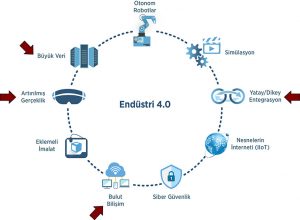
Mrugalska and Wyrwicka (2017) describe the concept of industry 4.0, “integration of complex physical machines and devices with networked sensors and software used to better predict, control and plan commercial and social outcomes” or “a new value chain organization throughout the product lifecycle. and management level ”. Industry 4.0 focuses on the optimization of value chains due to its autonomous control and dynamic production. It covers the design and implementation of competitive products, services, strong and flexible logistics and production systems [8]. Can and Kıymaz (2016) state that Industry 4.0 plans all units that are directly or indirectly related to production to work together, and that digital data, software and information technologies work in an integrated manner [1]. Batista et al. (2017) say that industry 4.0 is an advanced stage of development in the organization and management of the entire value chain process in the manufacturing industry, sensor and actuator infrastructures [13]. According to Qin et al. (2016), industry 4.0 includes various companies, factories, suppliers, logistics, resources, customers, etc. means a complete communication network that will exist between. Here, each department optimizes their configurations in real time depending on the demand and condition of the relevant departments in the network. In other words, the future business network is influenced by each collaboration segment that can achieve a self-organizing status and deliver real-time responses [5]. Schumacher et al. (2016) reported that industry 4.0 is the backbone of the internet and support technologies (eg embedded systems) to integrate physical objects, human players, smart machines, production lines and processes along organizational boundaries [6].
The concept of Industry 4.0 is seen as an important strategy to survive in a competitive environment in the future. This includes the design and implementation of competitive products and services, as well as flexible logistics and manufacturing systems. Industrial companies are currently focusing on the term industry 4.0 to overcome challenges such as increased individualization of products, increased resource efficiency, and shortened time to market [14]. Industry 4.0 is driven by intelligent systems with autonomous features such as self-configuration, self-regulation and self-improvement will provide manufacturing ecosystems. Thus, new types of advanced production and industrial processes will emerge for machine-human cooperation and symbiotic product realization. As a result, it will allow us to achieve an unprecedented level of operational efficiency and accelerate our efficiency [15].
In Industry 4.0, a new type of product is emerging, which is called the smart product produced in production. These products are embedded with sensors, identifiable components and processors that carry information and provide feedback to the production system to convey functional guidance to customers [5]. Smart connected products offer exponentially expanding opportunities for new functionality, much greater reliability, much higher product utilization, and capabilities that can stand out and exceed traditional product boundaries [16]. Many functions can be added to these products, such as measuring the status of products or users, carrying this information, tracking products and analyzing them according to the results. Many advantages are also offered to customers by providing a new purchasing method under Industry 4.0. For example, their ideas can be received at any time during production or they can change their orders free of charge, even at the last minute. On the other hand, with smart products, customers are allowed not only to know the production information of the product, but also to get usage advice based on their own behavior [5].
Industry 4.0’s goals; To ensure collective customization of products produced by information technologies, to ensure automatic and flexible adaptation of the production chain, to monitor parts and products, to facilitate communication between parts, products and machines, to implement human-machine interaction (HMI) paradigms, to provide Internet-of-things-specific production optimization in smart factories and offering new types of services and business models in terms of value [4].
• Eliminating malfunctions in the demand chain,
• Optimizing decision making with real-time end-to-end visibility,
• Increased resource productivity (providing the highest output from a given volume of resources) and efficiency (using the least amount of resources possible to achieve a given output),
• Creating value opportunities (innovative services, new forms of employment, development opportunities for SMEs and new enterprises),
• Reducing energy and personal costs.
Industry 4.0 covers numerous technologies and associated paradigms [15]. Some of these emerging paradigms are Radio Frequency Identification (RFID), Enterprise Resource Planning (ERP), Internet of Things (IoT), Industrial Internet of Things (IIoT). , Cyber-Physical Systems (CPS), cloud-based manufacturing (Cloud Based Manufacturing-CBM), smart factory, smart product, etc. [4, 6,15]. These features are not only highly associated with internet technologies and advanced algorithms, but also point out that Industry 4.0 is a value-added computing and industrial value-added process [4].
RESOURCES
[1] A. V. Can ve M. Kıymaz, “Bilişim teknolojilerinin perakende mağazacılık sektörüne yansımaları: muhasebe departmanlarında endüstri 4.0 etkisi”, Sosyal Bilimler Enstitüsü Dergisi, CİEP Özel Sayısı, pp. 107-117, 2016.
[2] S. Sayer ve A. Ülker, “Ürün yaşam döngüsü yönetimi”, Mühendis ve Makina, cilt. 55, no.657, pp. 65-72, 2014.
[3] K. Witkowski, “Internet of things, big data, industry 4.0–innovative solutions inlogistics and supply chains management”,Procedia Engineering, vol. 182, pp. 763-769, 2017.
[4] L.U. Yang, “Industry 4.0: a survey ontechnologies, applications and open researchissues. Journal of Industrial Information Integration, in press.
[5] Q. Jian, L. Ying and R. Grosvenor, “Acategorical framework of manufacturing forindustry 4.0 and beyond”, Procedia CIRP,vol. 52, pp. 173-178, 2016.
[6] S. Andreas, E. Selim and W. Sihn, “Amaturity model for assessing industry 4.0readiness and maturity of manufacturingenterprises”, Procedia CIRP, vol. 52, pp.161-166, 2016.
[7] C. Prinz, F. Morlock, S. Freith, N.Kreggenfeld, D. Kreimeier and B.Kuhlenkötter, “Learning factory modules forsmart factories in industrie 4.0”, ProcediaCIRP, vol. 54, pp. 113-118, 2016.
[8] B. Mrugalska and M.K. Wyrwicka,“Towards lean production in industry 4.0.”,Procedia Engineering, vol. 182, pp. 466-473, 2017.
[9] A. J. Trappey, C. V. Trappey, U. H.Govindarajan, A. C. Chuang and J. J. Sun,“A review of essential standards and patent landscapes for the internet of things: a keyenabler for industry 4.0”, Advanced Engineering Informatics, in press.
[10] Ege Bölgesi Sanayi Odası AraştırmaMüdürlüğü, “Sanayi 4.0: uyum sağlayamayan kaybedecek, Ekim 2015.
[11] A. Sinan, “Üretim için yeni bir izlek: sanayi4.0”, Journal of Life Economics, no. 8, pp.19-30, 2016.
[12] J. Herter and J. Ovtcharova, “A model based visualization framework for cross disciplinecollaboration in industry 4.0 scenarios”,Procedia CIRP, vol. 57, pp. 398-403, 2016.
[13] N. C. Batista, R. Melício and V. M. F.Mendes, “Services enabler architecture forsmart grid and smart living services providers under industry 4.0”, Energy andBuildings, vol. 141, pp. 16-27, 2017.
[14] F. Rennung, C. T. Luminosu and A.Draghici, “Service provision in theframework of industry 4.0.”, Procedia-Social and Behavioral Sciences, vol. 221,pp. 372-377, 2016.
[15] L. Thames and D. Schaefer, “Softwaredefinedcloud manufacturing for industry4.0.”, Procedia CIRP, vol. 52, pp. 12-17,2016.
[16] E. Hofmann and M. Rüsch, “Industry 4.0and the current status as well as futureprospects on logistics”, Computers inIndustry, vol. 89, pp. 23-34, 2017.
[17] M. Landherr, U. Schneider and T.Bauernhansl, “The application centerindustrie 4.0-industry-driven manufacturingresearch and development”, Procedia CIRP,vol. 57, pp. 26-31, 2016.
[18] S. Aksoy, “Değişen teknolojiler ve endüstri4.0: endüstri 4.0’ı anlamaya dair bir giriş”,SAV Katkı, cilt., 4, pp. 34-4, 2017.
[19] S. Wang, J. Wan, D. Zhang, D. Li and C.Zhang, “Towards smart factory for industry4.0: a self-organized multi-agent systemwith big data based feedback andcoordination”, Computer Networks, vol.101, pp. 158-168, 2016.
[20] T. Stock and G. Seliger, “Opportunities ofsustainable manufacturing in industry 4.0”,Procedia CIRP, vol. 40, pp. 536-541, 2016.
[21] S. Erol, A. Jäger, P. Hold, K. Ott ve W.Sihn, “Somut Endüstri 4.0: üretimin geleceği için öğrenmeye yönelik senaryo temelli bir yaklaşım”, Procedia CIRP, cilt. 54, sayfa 13-18, 2016.
# Industry40 #IoT #iot #profinet #profibus #robotik #kablo


