
Industry 4.0 and Smart Factories
Aralık 30, 2020INTERNET OF THİNGS
Şubat 10, 2021
Cyber-Physical Systems and Smart Factories
The whole of the structures that contain communication and coordination between the physical world and the cyber world are called CyberPhysical Systems (CPS) [11]. The main role of CPS is to fulfill the agile and dynamic requirements of production and to increase the efficiency and productivity of the whole industry [4]. Industry 4.0 is characterized by an unprecedented connectivity of the Internet and the so-called CPS, which can be considered as systems that bring together the physical and virtual world. is. More precisely, “cyber-physical systems are the integration of computing with physical processes. This provides a completely new degree of control, oversight, transparency and efficiency in the production process. CPS realizes the integration of networks using multiple sensors, actuators, control processing units and communication devices as shown in Figure 2 [16].
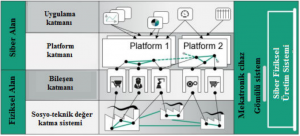
Figure 2. Cyber-physical production systems-CPPS [17]
Internet of Things
The structures that enable the communication of objects with each other are called the Internet of Things (IoT) [11]. The Internet of Things is expected to open up numerous economic opportunities and is considered one of the most promising technologies with great destructive potential [16]. The concept of the internet of things was created by a British entrepreneur Kevin Ashton. The idea was formulated in 1999 to describe a system where the material world communicates with computers (data exchange) with ubiquitous sensors. In this approach, not only objects, but also processes, data, people, and even animals or atmospheric phenomena – are treated as a variable, creating a system of everything [3].
In the first decade of the 21st century, the term “internet of things” became popular and it was considered as a technology that enables industries to move from Industry 3.0 to Industry 4.0 by adding information to products and processes in the supply chain [9, 16]. Technically speaking, IoT is a collection of physical artifacts that includes embedded systems of electrical, mechanical, computer, and communication mechanisms that enable internet-based communication and data exchange.
IoT – Internet of Things
IoT is an abstract idea that captures a movement that started when we started integrating computing and communication technology into many of the “things” we use at home and in our workplace.
It started with the idea of labeling and tracking “objects” with low-cost sensor technologies such as radio frequency identification (RFID) devices. However, the paradigm has changed as the market started offering low-cost computing and internet-based communication technologies with the rise of the ubiquitous smartphone. A perfect storm of low cost computing and pervasive broadband network has allowed IoT to evolve. Some examples of industrial IoT as shown in Figure 3; It includes a wide range of devices such as sensors, actuators, robots, milling machines, 3D printers and assembly line components, chemical mixing tanks, motors, insulin and infusion pumps, health devices, even planes, trains and automobiles [15].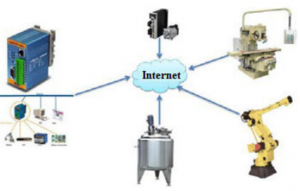
Figure 3. Internet of Things (15]
Cloud Based Manufacturing
Cloud-based manufacturing (CBM) is another rising paradigm that will make a significant contribution to the success of Industry 4.0. CBM has a network that leverages on-demand access to a shared set of diversified and distributed generation resources to create temporary, reconfigurable cyber-physical production lines that increase efficiency, reduce life cycle costs and allow optimum resource allocation to respond to customer-generated variable demand. It can be defined as a connected production model.
CBM
The features of CBM include networked manufacturing, scalability, agility, ubiquitous accessibility and virtualization, big data and IoT, everything for the service and pool of resources. Figure 4 shows the simplified software defined cloud production architecture. Simplified software-defined cloud production architecture [15] While the hardware plane in Figure 4 performs the final job, the software plane defines how the work will be organized until the job is completed.
The hardware plane has a distributed hardware layer. This layer also consists of distributed hardware elements such as a 3D printer. The software plane contains two layers, virtual and control layers. The control layer consists of control elements and the virtual layer contains the end user applications. Information streams are indicated by arrows. The distributed hardware layer communicates with the control layer mutually. Likewise, the virtual layer interfaces with the control layer [15].
RESOURCES
[1] A. V. Can and M. Kıymaz, “Reflections of information technologies on retail retail sector: Industry 4.0 effect on accounting departments”, Journal of Social Sciences Institute, CİEP Special Issue, pp. 107-117, 2016.
[2] S. Sayer and A. Ülker, “Product life cycle management”, Mühendis ve Makina, vol. 55, no.657, pp. 65-72, 2014.
[3] K. Witkowski, “Internet of things, big data, industry 4.0 – innovative solutions inlogistics and supply chains management”, Procedia Engineering, vol. 182, pp. 763-769, 2017.
[4] L.U. Yang, “Industry 4.0: a survey ontechnologies, applications and open researchissues. Journal of Industrial Information Integration, in press.
[5] Q. Jian, L. Ying and R. Grosvenor, “Acategorical framework of manufacturing forindustry 4.0 and beyond”, Procedia CIRP, vol. 52, pp. 173-178, 2016.
[6] S. Andreas, E. Selim and W. Sihn, “Amaturity model for assessing industry 4.0readiness and maturity of manufacturingenterprises”, Procedia CIRP, vol. 52, pp.161-166, 2016.
[7] C. Prinz, F. Morlock, S. Freith, N.Kreggenfeld, D. Kreimeier and B.Kuhlenkötter, “Learning factory modules forsmart factories in industrie 4.0”, ProcediaCIRP, vol. 54, pp. 113-118, 2016.
[8] B. Mrugalska and M.K. Wyrwicka, “Towards lean production in industry 4.0.”, Procedia Engineering, vol. 182, pp. 466-473, 2017.
[9] A. J. Trappey, C. V. Trappey, U. H. Govindarajan, A. C. Chuang and J. J. Sun, “A review of essential standards and patent landscapes for the internet of things: a keyenabler for industry 4.0”, Advanced Engineering Informatics, in press.
[10] Aegean Region Chamber of Industry Research Directorate, “Industry 4.0: those who cannot adapt will lose, October 2015.
[11] A. Sinan, “A new path for production: industry4.0”, Journal of Life Economics, no. 8, pp. 19-30, 2016.
[12] J. Herter and J. Ovtcharova, “A model based visualization framework for cross disciplinecollaboration in industry 4.0 scenarios”, Procedia CIRP, vol. 57, pp. 398-403, 2016.
[13] N. C. Batista, R. Melício and V. M. F. Mendes, “Services enabler architecture forsmart grid and smart living services providers under industry 4.0”, Energy and Buildings, vol. 141, pp. 16-27, 2017.
[14] F. Rennung, C. T. Luminosu and A. Draghici, “Service provision in theframework of industry 4.0.”, Procedia-Social and Behavioral Sciences, vol. 221, pp. 372-377, 2016.
[15] L. Thames and D. Schaefer, “Softwaredefinedcloud manufacturing for industry4.0.”, Procedia CIRP, vol. 52, pp. 12-17,2016.
[16] E. Hofmann and M. Rüsch, “Industry 4.0 and the current status as well as futureprospects on logistics”, Computers inIndustry, vol. 89, pp. 23-34, 2017.
[17] M. Landherr, U. Schneider and T.Bauernhansl, “The application centerindustrie 4.0-industry-driven manufacturingresearch and development”, Procedia CIRP, vol. 57, pp. 26-31, 2016.
[18] S. Aksoy, “Changing technologies and industry4.0: an introduction to understanding industry 4.0”, SAV Contribution, vol., 4, pp. 34-4, 2017.
[19] S. Wang, J. Wan, D. Zhang, D. Li and C. Zhang, “Towards smart factory for industry4.0: a self-organized multi-agent system with big data based feedback and coordination”, Computer Networks, vol.101, pp. 158-168, 2016.
[20] T. Stock and G. Seliger, “Opportunities ofsustainable manufacturing in industry 4.0”, Procedia CIRP, vol. 40, pp. 536-541, 2016.
[21] S. Erol, A. Jäger, P. Hold, K. Ott and W. Sihn, “Concrete Industry 4.0: a scenario-based approach to learning for the future of manufacturing”, Procedia CIRP, vol. 54, pp 13-18, 2016.
# Industry40 #IoT #iot #profinet #profibus #robotik #kablo


